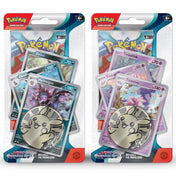
Ten billion. That's the number The Pokémon Company released today: 10 billion Pokemon TCG cards were printed between March 2025 and March 2026 – enough to give every person on Earth 1.25 cards. The lifetime total now stands at over 85 billion cards worldwide. And yet, demand still exceeds this print volume. What these numbers really mean, why Pokémon Pocket apparently triggered the current boom, and what the new printing factory from 2028 will mean for collectors and investors.
The Numbers in Context
Before the 10-billion figure can be properly assessed, a historical perspective is needed. The official production figures from The Pokémon Company since 2020:
| Fiscal Year (to March) | Total Stock | Annual Growth |
|---|---|---|
| 2026 | over 85 billion | +10.0 billion |
| 2025 | over 75 billion | +10.2 billion |
| 2024 | over 64.8 billion | +11.9 billion (Record) |
| 2023 | over 52.9 billion | +9.7 billion |
| 2022 | over 43.2 billion | +9.1 billion |
| 2021 | over 34.1 billion | +3.7 billion |
Before 2019, Pokémon produced an average of 1.5 to 2 billion cards per year. In 2021, 2022, and 2023, this volume increased fivefold. And then, the remarkable fact: for two consecutive years, production has been almost exactly 10 billion cards.
That is not a decision – that is a ceiling.
Why 10 Billion is a Production Limit, Not a Goal
The Pokémon Company officially confirmed in early 2025 that it was printing at maximum capacity. The figure of ~10 billion does not reflect demand, but rather the physical maximum of current printing capacities. More would have been printed if it had been possible.
With the current figures, more than 1 in 9 of all Pokémon cards ever printed were produced in the 2025/2026 fiscal year – approximately 11.76% of all existing cards come from this single year. At the same time, around 50% of all Pokémon cards ever printed originate from the last four years. Half of the entire 30-year printing history of the TCG – in four years.
Pokémon Pocket: The Trigger of the Current Boom
To understand why the market has been booming since 2025, one must take a step back.
In October 2024, Pokémon TCG Pocket launched. Five months later, in March 2025, TPCi was already printing at its limit. Surging Sparks in November 2024 and Prismatic Evolutions in January 2025 immediately sold out, and shortages have persisted ever since.
What Pocket triggered is not hard to explain: millions of people who had never played the physical TCG or had not touched it for a long time were drawn back into the world of Pokémon cards through the app. A portion of them then also bought physical products. The effect was a demand-side shock that no printing company in the world could have compensated for in a short time.
Pocket itself generated 1.25 billion USD – and attracted casual players whose demand for physical cards has continued ever since.
The Printing Factory That is Set to Change Everything
In December 2025, Millennium Print Group – The Pokémon Company International's main printing partner – announced the solution to the bottlenecks: a new production facility of 1.27 million square feet (approx. 118,000 m²), the largest US production lease of 2025. Construction began in 2026, with planned commissioning: end of 2028.
What this means in practice: The printing capacity will approximately double with the new plant. From 10 billion cards per year, it could become 18-20 billion.
The community expects the market to stabilize from 2028 – once the new plant goes online and the overproduction of recent years is normalized. Until then, supply will remain structurally tight.
What This Means for the Mega Era: Small Sets as a Strategy
It is no coincidence that the English Mega-Era sets since Perfect Order are significantly smaller than earlier sets. Fewer unique cards mean that more printing capacity can be concentrated on the remaining cards. More copies of a card exist – which theoretically improves availability.
From the community's perspective, this is a clever move: the average collector is less interested in the size of a card list than in being able to actually buy the set. The result is more supply per card.
For collectors who are after Chase Cards, however, there is a downside: fewer cards in the set means that the hunt for SIRs and Mega Hyper Rares becomes more intense – because the pool is smaller and more people are aiming for the same cards.
What This Specifically Means for Investors
Three conclusions that can be directly drawn from today's figures:
1. Shortages are structural, not temporary. For those who hoped that the scarcity of popular products would be over in six months: The printing plant is running at its limit. The new plant will not be operational until the end of 2028 at the earliest. Until then, the supply of popular sets and products will remain structurally below demand.
2. Sealed products benefit. Those who secure displays or Elite Trainer Boxes from current sets at MSRP hold products whose secondary market value is supported by this supply scarcity. This is not an insider tip – it is the direct consequence of the production ceiling.
3. Keep 2028 in mind as a turning point. When the new factory becomes operational, supply will increase dramatically. What this means for secondary market prices of current sets is not yet clear – but collectors and investors with a 3-year horizon should be aware of this date.
The 30-Year Perspective
2026 marks the 30th anniversary of the Pokémon TCG. Today's figures come as part of the official anniversary report: 85 billion cards and 515 million video games shipped since launch. For those wondering whether the franchise operates in a stable or shrinking market – the production figures provide a clear answer. The Mega-Evolution era is not the end of a cycle. It is the peak of the largest wave of demand in the game's history so far.
FAQ
How many Pokémon TCG cards were printed in 2025? From March 2025 to March 2026, according to the official report from The Pokémon Company, around 10 billion Pokémon cards were printed worldwide. The lifetime total now stands at over 85 billion cards in 16 languages and over 90 countries.
Why are there still shortages if so many cards are being printed? Because printing capacity has been at its absolute maximum since early 2025. The Pokémon Company has officially confirmed that demand exceeds production capacity. The trigger was the launch of Pokémon TCG Pocket in October 2024 and the resulting boom for the physical TCG.
When will the availability of Pokémon cards improve? Millennium Print Group, TPCi's main printing partner, is currently building a new 1.27 million square foot facility. It is expected to be operational by the end of 2028 and will approximately double capacity. A structural improvement in supply is not expected until 2028/2029 at the earliest.
How many Pokémon cards are there in total? As of March 2026, over 85 billion Pokémon cards have been printed worldwide – with approximately 50% of them coming from the last four years alone.
What does the production crisis mean for the value of Pokemon cards? Structural scarcity coupled with high demand supports secondary market prices for popular products. Sealed products like displays and Elite Trainer Boxes from sought-after sets tend to benefit from this dynamic as long as supply remains limited.